Contact us at youthandpolitics0720@gmail.com or visit us at @youthnpolitics on instagram
Would You Still Love Me If I Was A Communist? Origins of the US-Cuban Blockade

Written and Researched By: Mairead He
Published By: Meredith Yuen
Published: 27 April 2026
Since 1960, the United States has enforced an embargo on Cuba, the longest trade embargo in modern history. For decades, Cuban access to economic trade, financial aid, food, and medicine has been severely restricted. To understand this undoubtedly extreme policy, one must first understand the early history of US-Cuban relations, American intervention in Cuba, and the impact of Castro’s revolution.

https://jacobin.com/2025/03/cuba-medical-programs-us-sanctions (Uploaded August 3, 2025, Retrieved April 16, 2026)
Establishment of US-Cuba Relations
Cuban-US relations can be traced all the way back to Cuba’s fight for independence from Spain. From 1492, when Christopher Colombus first landed on Cuban soil, till independence in 1898, Cuba was a colony of the Kingdom of Spain. By 1868 there was a growing call for independence. Wealthy landowners in Cuba, particularly in the eastern parts of the country, were frustrated with the lack of political representation in the Spanish parliament and a six percent tax increase on Cuban planters and businesses. [1] Furthermore, the abolitionist movement was gaining traction in Cuba. Although Spain had abolished slavery on the mainland in 1820, the institution continued in its colonies. With new farming technologies and techniques being developed, slavery became largely unnecessary and expensive, further fueling calls for abolition within Cuba. [2] This growing discontent led to the Ten Years’ War (1868-1878), the first of three wars for Cuba’s independence.
The Cuban War of Independence (1895-1898) was the last of the three wars and saw Cuba’s independence from the Spanish Empire. [3] This time period also saw the first notable instance of American involvement in Cuba and laid the groundwork for the diplomatic connections between the two nations. The US had long had a vested interest in Cuba. Following the Ten Years’ War, U.S. businessmen monopolized the sugar markets in Cuba, and by 1894, 90% of Cuba’s total exports went to the US, twelve times the number of exports to Spain. [4] While Spain held political authority over Cuba, it was the US that held economic power. This position of power was one that the US would continue to hold for decades to come. US economic interests continued to suffer under the prolonged conflict. Shipping firms had relied heavily on trade with Cuba, and investments in Cuban sugar grew more vulnerable as political uncertainty deepened. [5]
Additionally, José Martí, the face of the Cuban revolutionary movement, had established offices in Florida. These offices worked with leading newspapers and government officials, holding fund-raising events and mounting an extensive propaganda campaign, which saw enormous popular support for Cuba. [6] For many Americans, the Cuban revolt mirrored the American Revolution, and the Spanish government came to be viewed as a tyrannical oppressor. Further fueling this sentiment were reports of the policy of reconcentration in Cuba, which killed at least 170,000 Cuban civilians. [7] As negotiations continued to fail, the final blow was dealt with the sinking of the armed cruiser USS Maine. The Maine had sunk whilst docked in Havana Harbor after a spontaneous explosion. While the culprit was never confirmed, the incident was blamed on the Spanish and triggered the Spanish-American War. [8]

The 1898 Teller Amendment, passed by the US Congress, declared that “the island of Cuba is, and by right should be, free and independent." The amendment affirmed US support for Cuban independence whilst assuring that the US couldn’t annex the island, which also restricted the US military’s presence in Cuba.[9] War was declared on April 25th, 1898. Due to the existing efforts of Cuban revolutionaries and American military superiority over Spain, the war was over by August 12th, when the US and Spain signed a protocol of peace. On December 10th, 1898, the Treaty of Paris was signed, which demanded the formal recognition of Cuban independence but did not set a designated time limit for US occupation. [10] The Cubans were prevented from participating in peace talks.
Cuba gained formal independence on the 20th of May, 1902, with the end of US military government jurisdiction. However, this independence came with a limitation. The Platt Amendment, which stipulated the terms for the withdrawal of US troops, is perhaps one of the most crucial elements of US-Cuban relations. The amendment’s terms limited Cuba’s rights to negotiate treaties with the US, ceded the right to Guantánamo Bay to the US, and allowed for US intervention in Cuba “for the preservation of Cuban independence." These terms were incorporated into the Cuban constitution of 1901. [11] In many ways, Cuba replaced one colonial power with another. Between 1902 and 1921, the US intervened militarily four times to ensure that Cuba implemented policies beneficial for US investments.
Batista Regime and Revolution
Opposition to US involvement and Cuba’s economic dependence on the US inspired two student movements in 1923 and 1927, both based on Marti’s anti-imperialism. Increasing unrest throughout the 1920s resulted in a coup, staged by army NCOs, against the US-installed government of Carlos Manuel de Céspedes. The new government, led by Ramón Grau San Martín, abolished the Platt Amendment, gave women voting rights, cut prices, and increased wages. These new reforms threatened American businesses in Cuba, and once again US military intervention was suggested.
In 1933, Fulgencio Batista was persuaded by US ambassadors to impose a puppet presidency that would protect US interests in Cuba. Batista had been the leader of the NCO army group and thus had control of the military. By 1934, the short-lived era of reform ended. Throughout the 1930s there were a series of pro-US governments, with Batista and the army being the real power behind the presidents. In 1952, Batista led a coup and cancelled elections, ruling directly till 1959. [12]
Under both Batista’s covert and direct rule, corruption and inequality permeated Cuban society. In 1953, 15-20% of the labor force was chronically unemployed, and only a third of homes had running water. [13] Havana essentially became, according to playwright Arthur Miller, “a Mafia playground and a bordello for Americans and other foreigners.” Batista established relationships with American mobsters and greatly encouraged large-scale gambling and prostitution in Cuba. [14]
Aside from organized crime, US companies owned around 90% of Cuban mines, 80% of public utilities, 50% of railways, 40% of sugar production, and 25% of bank deposits by the late 1950s. [15] By 1957, US private investments made a profit of $350 million, largely aided by Batista’s measures that encouraged foreign investment through tax exemptions and allowed US companies to hold monopolies in consumer goods.
The combination of government corruption and rampant wealth inequality eventually culminated in the 1959 Cuban Revolution. In a 1953 speech, Fidel Castro, the leader of the revolution, listed “five revolutionary laws” to be implemented in Cuba, including land reforms, the right of industrial workers to a 30% share of company profits and the right of sugar workers to receive 55% of company profits. [16]

(Fidel Castro addresses a crowd in a park in front of the presidential palace in Havana, Cuba, January 1959. Photograph: Harold Valentine/AP. https://www.theguardian.com/news/2016/dec/16/looking-back-castro-cuba-revolution)
Castro Era and Nationalization
The Castro era brought about significant changes to Cuban policy and US-Cuban relations. One of Castro’s most high-profile decisions was the policy of nationalization. The first agrarian reform was implemented in May of 1959, eliminating latifunidos and granting ownership and titles to workers who had worked on such lands. The law also limited farm and real estate sizes, expropriating and redistributing any excess land to state-run communes. Furthermore, the reform law prohibited foreigners from obtaining Cuban land ownership. [17] As the law went into effect, the US government issued an official statement of protest on the behalf of owners of 34 major American sugar mills, who had lodged complaints with the US embassy. [18] Although the protests went unanswered, they were the first of many conflicts between Castro’s administration and the US government.

(Thousands of workers received titles to the land they worked. Photograph: Arlin Alberty Loforte/PCC https://en.granma.cu/cuba/2019-05-17/a-reform-that-illuminated-the-land )
The US initially took a stance of cautious support for Castro’s revolution. Eisenhower’s administration recognized the new Cuban government following the revolution, and in April of 1959 Castro held an 11-day visit to the US, openly speaking of plans to nationalize Cuban lands. [19] However, this tenuous relationship quickly fell through as Castro began to implement nationalization. Castro’s agrarian reform caused almost 40% of arable land in Cuba to be removed from foreign owners and corporations and distributed to farmers and agricultural workers; foreigners were also prohibited from owning sugar plantations. [20] US businessmen and companies held around $900 million in investments in Cuba in 1959 (approximately $7.4 billion as of 2024). As a result, the US reduced its import quota of brown sugar from Cuba in 1960. In response to US sanctions, Castro’s administration moved to nationalize industry. In August of 1960, the Cuban government nationalized three American-owned oil refineries, 36 sugar mills—US investors owned around 40% of sugar production in Cuba—and the Cuban Telephone Company, a US consortium of the International Telephone and Telegraph Company. [21] As American property was increasingly nationalized, the US government responded with increasingly severe countermeasures, culminating in a prohibition of all exports to Cuba on the 19th of October, 1960, with an exemption for food and medicine. [22]
Immediately following the embargo announcement, Cuba nationalized all American businesses and most American private property on the island, with Castro promising to confiscate American possessions in Cuba “down to the nails in their shoes." [23] Furthermore, compensation was to be paid from the sale of Cuban sugar to the US, but as said sale had been canceled by Eisenhower’s administration, no compensation was paid. As one of his final actions in office, Eisenhower severed all diplomatic relations with Cuba in January of 1961, shutting down the embassy in Havana. [24]
The Impact of the Cold War
The impact of the Cold War on the Cuban embargo cannot be understated, as it was often the deciding factor in US-Cuban relations, particularly after the Eisenhower era. The initial arms embargo on Cuba, enacted during the Cuban Revolution, quickly escalated into a proxy for US-Soviet (USSR) rivalry during the Cold War.
During his 1959 address to the United Nations, Castro had declared Cuba neutral in the Cold War, saying, “I know the world thinks of us; we are Communists, and of course I have said very clearly that we are not Communists, very clearly." [25] Like many governments and states that emerged during the Cold War, Cuba had to choose between the two major superpowers—the US and the Soviet Union—for allyship, trade, and aid. Thus, despite growing suspicion over the Agrarian Reform Law and Castro’s appointment of communist Nuñez Jimenez as head of the reform program, Eisenhower initially refused any aggression against Cuba for fear that it would push Cuba towards an alliance with the USSR. [26] And yet, subsequent US policies did exactly that.
As early as May of 1960, the Cuban government began purchasing armaments from the Soviets, citing the US arms embargo, which had continued since the Batista era. Cuban-Soviet relations quickly grew to include trade agreements, as trade with the US became increasingly restricted. When Eisenhower’s government refused to export oil to the island a month later, Cuba became reliant on Soviet crude oil. The US viewed this trade agreement as a provocation, urging major US oil companies to refuse to process Soviet oil in their Cuban refineries. In response, Cuba confiscated said refineries. The US thus reduced its brown sugar imports in July, and once again the USSR stepped in to replace the quota. [27] Likewise, when the US placed an embargo on most exports to Cuba, the Soviets increased their import of Cuban sugar and agreed to fill Cuba’s import gap. [28] For the Soviets, Cuba didn’t just provide much-needed sugar imports. Cuba’s proximity to the US, Castro’s anti-US sentiments, and his administration’s willingness to back revolutions around Latin America made them a valuable asset for expanding Soviet influence in the region. Similarly, Eisenhower stated in 1960 that the ultimate factor deciding his policies against Cuba was “the degree to which Cuba had been handed over to the Soviet Union as an instrument with which to undermine our position in Latin America.” [29] As such, Cuba became yet another flash point in Cold War tensions.
Castro’s rejection of the communist label changed following the Bay of Pigs invasion of 1961, which further soured relations with the US. After the failed operation, Castro characterized his state as "socialist," explicitly aligning his ideology with the USSR.[30] As a result, Congress passed the Foreign Assistance Act, prohibiting aid to Cuba and authorizing the president to impose a complete trade embargo against the country. Under US pressure, the Organization of American States (OAS) suspended Cuba on January 21, 1962. The organization also imposed multilateral sanctions, which were only rescinded in 1975. [31]

(Members of Cuban Assault Brigade 2506 after their capture at the Bay of Pigs, Cuba, April 1961. Photo: AFP)
In 1962, President Kennedy extended US measures against Cuba, widening the scope of trade restrictions twice. As such, the embargo was expanded to include all imports of products containing Cuban goods, economically isolating Cuba by discouraging trade agreements with other countries. In August of the same year, the aforementioned Foreign Assistance Act was amended, prohibiting aid to any country that provided assistance to Cuba. [32] At a time when many countries depended on US economic aid, this measure was particularly significant.
Long-Term Effects of the Blockade
The longest trade embargo in modern history, the US embargo has lasted since 1960 and had a devastating impact on the Cuban economy. In declassified CIA documents, the stated goal of both the embargo and militaristic intervention in Cuba was “to bring about Castro’s overthrow or force him to make basic changes in his policy." [33] Although this goal has not been achieved, the embargo has created a decades-long humanitarian crisis on the island.
With the dissolution of the Soviet Union in 1991, Cuba lost its most important economic ally. The USSR alone had imported around 80% of Cuban sugar and 40% of Cuban citrus, on top of providing most of the oil imports to Cuba. Within two years of the Soviet Union’s dissolution, oil imports to Cuba dropped from 13 million tons to 3 million tons. Furthermore, Comecon, a trade alliance between communist countries, which once accounted for almost 85% of Cuban trade, dissolved around the same time. [34] Since then, the embargo has been increasingly devastating.
International organizations and leaders have criticized the sanctions for limiting the availability of food, clean water, and medicine for the Cuban population. [35] The embargo has also been linked to shortages of medical supplies and soap, leading to an increase in infectious diseases, epidemics, nutritional deficiencies, and neurological disorders. [36] A 1997 report by the American Association for World Health (AAWH) found that the embargo contributed to malnutrition and a lack of access to water and medicine. The report also concluded that “a humanitarian catastrophe has been averted only because the Cuban government has maintained a high level of budgetary support for a health care system designed to deliver primary and preventative medicine to all its citizens.” [37] Additionally, AAWH found that the embargo limited the amount of medical information flowing into Cuba from the US, leaving the country vulnerable to new diseases and epidemics.
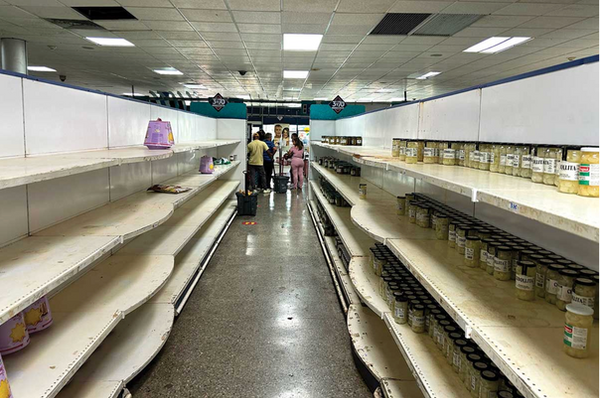
(The shelves of Havana’s largest supermarket are sparse. Photo: The Nation)
Another point of tension has been the Helms-Burton Act. Enacted in 1996, the bill penalized foreign companies that traded with Cuba. Canadian and European governments have been especially critical, arguing that the bill punished non-US corporations and investors with economic interests in Cuba, and the European Council has criticized the act for indirectly affecting the economic growth of countries with ties to the island. [38]
Formally opposed by Amnesty International, Human Rights Watch, the UN, and the Inter-American Commission on Human Rights, the now 66-year-long embargo has isolated Cuba and affected the most vulnerable populations on the island. Having outlived the Cold War and continued on into the 21st century, the embargo has not changed the regime in power, nor has it inspired a popular uprising amongst the Cuban people. Instead, it has choked a population of almost 11 million people, withholding economic aid, infrastructure, medicine, and food even as reports of medical crises continue to emerge. While the conversation around Cuba and its government is complex, one thing remains clear: the embargo needs to end.
Citations
[1] Louis A. Pérez, Cuba: Between Reform and Revolution (New York: Oxford University Press, USA, 2006), 80-89.
[2] Arthur F. Corwin, Spain and the Abolition of Slavery in Cuba, 1817-1886 (1967).
[3] "Cuban Independence Movement," Encyclopedia Britannica, last modified July 20, 1998, https://www.britannica.com/event/Cuban-Independence-Movement.
[4] Pérez, Cuba: Between Reform and Revolution, 138.
[5] David M. Pletcher, The Diplomacy of Trade and Investment: American Economic Expansion in the Hemisphere, 1865-1900 (Columbia: University of Missouri Press, 1998).
[6] Gary R. Mormino, "Cuba Libre, Florida, and the Spanish American War," Theodore Roosevelt Association Journal 31, no. ½ (2010): 43-54.
[7] "Spain's Reconcentrado Policy in Cuba (The Cuban Holocaust)," Latin American Studies, accessed April 16, 2026, https://www.latinamericanstudies.org/reconcentrado.htm.
[8] John L. Offner, An Unwanted War: The Diplomacy of the United States and Spain Over Cuba, 1895-1898 (Chapel Hill: UNC Press Books, 2014).
[9] Jose C. Navarro, History of Cuba (Havana, 1998), 71.
[10] Ibid., 77.
[11] "Platt Amendment," Encyclopedia Britannica, last modified July 20, 1998, https://www.britannica.com/topic/Platt-Amendment.
[12] "Fulgencio Batista (1901-1973) | American Experience | PBS," PBS: Public Broadcasting Service, last modified December 13, 2017, https://www.pbs.org/wgbh/americanexperience/features/castro-fulgencio-batista-1901-1973/.
[13] Servando Gonzalez, The Secret Fidel Castro: Deconstructing the Symbol (InteliNet/InteliBooks, 2001).
[14] T. J. English, Havana Nocturne: How the Mob Owned Cuba…and Then Lost It to the Revolution (New York: William Morrow, 2008), 132.
[15] Natasha Geiling, "Before the Revolution," Smithsonian Magazine: Explore History, Science, Arts & Culture, last modified July 31, 2007, https://www.smithsonianmag.com/history/before-the-revolution-159682020/.
[16] Hugh Thomas, The Cuban Revolution (HarperCollins College Division, 1977), 170.
[17] Peter G. Bourne, Fidel: A Biography of Fidel Castro (New York: Dodd Mead, 1986).
[18] Jane Franklin, Cuba and the U.S. Empire: A Chronological History (New York: NYU Press, 2016), 21.
[19] Andrew Glass, "Fidel Castro visits the U.S., April 15, 1959," Politico, April 15, 2013, accessed April 16, 2026, https://www.politico.com/story/2013/04/this-day-in-politics-april-15-1959-90037.html.
[20] Robert J. Alexander, "Agrarian Reform in Latin America," Foreign Affairs 41, no. 1 (1962): 191-207, doi:10.2307/20029609.
[21] Cubanew/acn, "March 1959: Intervention of the Cuban Telephone Company," Inicio - Cuban News Agency, last modified March 1, 2024, https://www.cubanews.acn.cu/cuba/23815-march-1959-intervention-of-the-cuban-telephone-company.
[22] Fabián E. Font, The Secret War: CIA Covert Operations Against Cuba, 1959-62 (Ocean Press (AU), 1995).
[23] and [24] William M. LeoGrande, "A Policy Long Past Its Expiration Date: US Economic Sanctions Against Cuba," Social Research: An International Quarterly 82, no. 4 (2015): 939-966, doi:10.1353/sor.2015.0055.
[25] "Cuban Revolution," UPI, last modified 1959, https://www.upi.com/Archives/Audio/Events-of-1959/Cuban-Revolution/.
[26] John Stanley, "What impact did the Cuban Revolution have on the Cold War?," Cambridge University Press, accessed April 16, 2026, https://assets.cambridge.org/97811076/98901/excerpt/9781107698901_excerpt2.pdf.
[27], [28] Stuart Davis, Sanctions as War: Anti-Imperialist Perspectives on American Geo-Economic Strategy (Leiden: Haymarket Books, 2023), 131.
[29] "Historical Documents," Latest News - Office of the Historian, accessed April 16, 2026, https://history.state.gov/historicaldocuments/frus1958-60v06/d551.
[30] John B. McConaughy, "Latin America - Soviet Target," Quarterly Review of Military Literature 41, no. 10 (October 1961): 45.
[31] "OAS Lifts 47-year-old Suspension of Cuba - CNN.com," Breaking News, Latest News and Videos | CNN, accessed April 16, 2026, https://www.cnn.com/2009/WORLD/americas/06/03/cuba.oas/index.html.
[32] Davis, Sanctions as War, 133.
[33] CIA Office of National Estimates, "The Situation and Prospects in Cuba," CIA, last modified November 3, 1961, https://www.cia.gov/readingroom/docs/CIA-RDP79R00904A000800010013-1.pdf.
[34] U.S. DEPARTMENT OF STATE, U.S. DEPARTMENT OF STATE BACKGROUND NOTES: CUBA, (THE BUREAU OF PUBLIC AFFAIRS, 1994), https://web.archive.org/web/20100621162240/http://dosfan.lib.uic.edu/ERC/bgnotes/wha/cuba9411.html.
[35] Davis, Sanctions as War, 144.
[36] Michèle Barry, "Effect of the U.S. Embargo and Economic Decline on Health in Cuba," Annals of Internal Medicine 132, no. 2 (2000): 151-154, doi:10.7326/0003-4819-132-2-200001180-00010.
[37] American Association for World Health, "Denial of Food and Medicine: The Impact Of The U.S. Embargo On The Health And Nutrition In Cuba," American University, Washington, D.C, last modified March 1997, https://www.american.edu/centers/latin-american-latino-studies/upload/impact-of-us-embargo-on-health-nutrition-in-cuba-1997.pdf.
[38] Peter KITTELMANN, "Report on the Proposal for a Council Regulation on Protecting Against the Effects of the Application of Certain Legislation of Certain Third Countries, and Actions Based Thereon, or Resulting Therefrom - Committee on External Economic Relations | A4-0329/1996 | European Parliament," accessed April 16, 2026, https://www.europarl.europa.eu/sides/getDoc.do?type=REPORT&mode=XML&reference=A4-1996-0329&language=EN.
Glossary
Abolitionist: A person who favors the abolition of a practice or institution. Here it refers to the movement to end slavery.
Military government: A government administered by the army, often used by occupying forces.
Guantanamo Bay: A US territory in Cuba that holds a military prison and naval station. The former was notably used to hold prisoners during the War on Terror and has been accused of numerous human rights violations.
Coup: An unlawful seizure of power from a government, often sudden and violent.
NCO: Non-commissioned officers. Officers who do not hold a commission and usually come to positions of authority by promotion through rank.
Nationalization: The transfer of industry or commerce from private to state-owned.
Latifundios: A large estate or plantation, often owned by an individual, family or foreign corporation.
Expropriating: A state confiscating private property for public use.
Sanctions: Commercial or financial penalties applied by states against states, groups or individuals, often through refusing trade or freezing financial assets.
Embargo: A ban on trade or commercial activity with a particular country.
Cold War: A period of geopolitical rivalry between the US and USSR, lasting from 1947 to 1991.
Bay of Pigs: A failed US invasion of Cuba carried out by CIA-trained Cuban exiles.
Multilateral sanctions: Sanctions issued collectively by multiple organizations or states
References
Alexander, Robert J. "Agrarian Reform in Latin America." Foreign Affairs 41, no. 1 (1962), 191. doi:10.2307/20029609.
American Association for World Health. "Denial of Food and Medicine: The Impact Of The U.S. Embargo On The Health And Nutrition In Cuba." American University, Washington, D.C. Last modified March 1997. https://www.american.edu/centers/latin-american-latino-studies/upload/impact-of-us-embargo-on-health-nutrition-in-cuba-1997.pdf.
Barry, Michèle. "Effect of the U.S. Embargo and Economic Decline on Health in Cuba." Annals of Internal Medicine 132, no. 2 (2000), 151-154. doi:10.7326/0003-4819-132-2-200001180-00010.
Bourne, Peter G. Fidel: A Biography of Fidel Castro. New York: Dodd Mead, 1986.
CIA Office of National Estimates. "The Situation and Prospects in Cuba." CIA. Last modified November 3, 1961. https://www.cia.gov/readingroom/docs/CIA-RDP79R00904A000800010013-1.pdf.
Corwin, Arthur F. Spain and the Abolition of Slavery in Cuba, 1817-1886. 1967.
"Cuban Independence Movement." Encyclopedia Britannica. Last modified July 20, 1998. https://www.britannica.com/event/Cuban-Independence-Movement.
"Cuban Revolution." UPI. Last modified 1959. https://www.upi.com/Archives/Audio/Events-of-1959/Cuban-Revolution/.
Cubanew/acn. "March 1959: Intervention of the Cuban Telephone Company." Inicio - Cuban News Agency. Last modified March 1, 2024. https://www.cubanews.acn.cu/cuba/23815-march-1959-intervention-of-the-cuban-telephone-company.
Davis, Stuart. Sanctions as War: Anti-Imperialist Perspectives on American Geo-Economic Strategy. Leiden: Haymarket Books, 2023.
Font, Fabián E. The Secret War: CIA Covert Operations Against Cuba, 1959-62. Ocean Press (AU), 1995.
Franklin, Jane. Cuba and the U.S. Empire: A Chronological History. New York: NYU Press, 2016.
"Fulgencio Batista (1901-1973) | American Experience | PBS." PBS: Public Broadcasting Service. Last modified December 13, 2017. https://www.pbs.org/wgbh/americanexperience/features/castro-fulgencio-batista-1901-1973/.
Geiling, Natasha. "Before the Revolution." Smithsonian Magazine: Explore History, Science, Arts & Culture. Last modified July 31, 2007. https://www.smithsonianmag.com/history/before-the-revolution-159682020/.
Glass, Andrew. "Fidel Castro visits the U.S., April 15, 1959." Politico, April 15, 2013. Accessed April 16, 2026. https://www.politico.com/story/2013/04/this-day-in-politics-april-15-1959-90037.html.
Gonzalez, Servando. The Secret Fidel Castro: Deconstructing the Symbol. InteliNet/InteliBooks, 2001.
"Historical Documents." Latest News - Office of the Historian. Accessed April 16, 2026. https://history.state.gov/historicaldocuments/frus1958-60v06/d551.
KITTELMANN, Peter. "Report on the Proposal for a Council Regulation on Protecting Against the Effects of the Application of Certain Legislation of Certain Third Countries, and Actions Based Thereon, or Resulting Therefrom - Committee on External Economic Relations | A4-0329/1996 | European Parliament." Accessed April 16, 2026. https://www.europarl.europa.eu/sides/getDoc.do?type=REPORT&mode=XML&reference=A4-1996-0329&language=EN.
LeoGrande, William M. "A Policy Long Past Its Expiration Date: US Economic Sanctions Against Cuba." Social Research: An International Quarterly 82, no. 4 (2015), 939-966. doi:10.1353/sor.2015.0055.
McConaughy, John B. "Latin America - Soviet Target." Quarterly Review of Military Literature 41, no. 10 (October 1961).
Mormino, Gary R. "Cuba Libre, Florida, and the Spanish American War." Theodore Roosevelt Association Journal 31, no. ½ (2010), 43-54.
Navarro, Jose C. History of Cuba. Havana1998.
"OAS Lifts 47-year-old Suspension of Cuba - CNN.com." Breaking News, Latest News and Videos | CNN. Accessed April 16, 2026. https://www.cnn.com/2009/WORLD/americas/06/03/cuba.oas/index.html.
Offner, John L. An Unwanted War: The Diplomacy of the United States and Spain Over Cuba, 1895-1898. Chapel Hill: UNC Press Books, 2014.
"Platt Amendment." Encyclopedia Britannica. Last modified July 20, 1998. https://www.britannica.com/topic/Platt-Amendment.
Pletcher, David M. The Diplomacy of Trade and Investment: American Economic Expansion in the Hemisphere, 1865-1900. Columbia: University of Missouri Press, 1998.
Pérez, Louis A. Cuba: Between Reform and Revolution, 3rd ed. New York: Oxford University Press, USA, 2006.
"Spain's Reconcentrado Policy in Cuba (The Cuban Holocaust)." Latin American Studies. Accessed April 16, 2026. https://www.latinamericanstudies.org/reconcentrado.htm.
Stanley, John. "What impact did the Cuban Revolution have on the Cold War?" Cambridge University Press. Accessed April 16, 2026. https://assets.cambridge.org/97811076/98901/excerpt/9781107698901_excerpt2.pdf.
T. J. English. Havana Nocturne: How the Mob Owned Cuba…and Then Lost It to the Revolution. New York: William Morrow, 2008.
Thomas, Hugh. The Cuban Revolution. HarperCollins College Division, 1977.
U.S. DEPARTMENT OF STATE. U.S. DEPARTMENT OF STATE BACKGROUND NOTES: CUBA. THE BUREAU OF PUBLIC AFFAIRS, 1994. https://web.archive.org/web/20100621162240/http://dosfan.lib.uic.edu/ERC/bgnotes/wha/cuba9411.html.

